Deterministic orchestration
State machines, explicit events, and replayable transitions come before any prompt-driven execution path.
Rustabaka helps engineering teams run AI-driven delivery with deterministic orchestration, operator visibility, and control over every important step.
Built for real-world engineering teams
State machines, explicit events, and replayable transitions come before any prompt-driven execution path.
Operators can follow work from project to issue to subtask to agent task without reconstructing history from logs.
Stronger models can plan and review while cheaper execution paths handle routine implementation and follow-up.
Comparison
Local and web coding agents are great at executing tasks. Rustabaka is built for the layer above that: shared delivery memory, workflow control, and cost-aware execution.
Local or vendor-hosted coding sessions around a repository and a prompt.
Customer-owned workflow layer deployed in your own cloud to coordinate agent work.
Work moves from an agent session to managed delivery.Context is scattered across threads, repo docs, instructions, task history, and per-user memories.
The company controls what enters the shared memory graph; agents use relevant memory when it helps.
Agents execute faster and spend fewer tokens because context is reusable, not rediscovered.Starts from prompts, Slack mentions, Linear assignments, or manually framed tasks.
Starts from managed intake, workflow events, and monitoring signals with routing rules.
Requests enter the right workflow without engineers translating every signal by hand.Best when a human frames context, supervises progress, and decides what to do next.
Bounded workflows keep moving until a gate, blocker, review, or escalation is required.
Small non-critical changes can progress with little engineering handholding; larger projects move forward with technical supervision at critical points.Can follow instructions and run checks, but rule enforcement depends on the session and reviewer.
Deterministic workflow steps, approvals, retries, and blockers enforce delivery rules as state transitions.
Happy paths move forward automatically; failed checks trigger rework or stop the workflow for required approval.Progress and history live across sessions, task pages, PRs, and comments.
Project, issue, subtask, run, artifact, review, and blocker state is visible in one admin surface.
Engineering teams see delivery progress and failure points without reconstructing history from tools and chat.Spend grows with ad hoc sessions, repeated context, retries, and human coordination.
Deterministic orchestration uses no agents; tokens are spent only on planning, coding, and review work.
Cost becomes visible by project, task, and service instead of disappearing into individual sessions.Strong once a human brings in the relevant external signal and frames the fix.
Built to connect monitoring, cloud, and workflow systems into ticket, rollback, and autofix flows.
External system signals can become managed work instead of waiting for manual triage.Workflow

Inbound webhooks stay short, idempotent, and operationally boring.
Project, issue, and sub-task structure turns incoming signals into manageable execution.
Operation (deterministic) and agent (LLM) runners do different jobs on purpose.
Execution
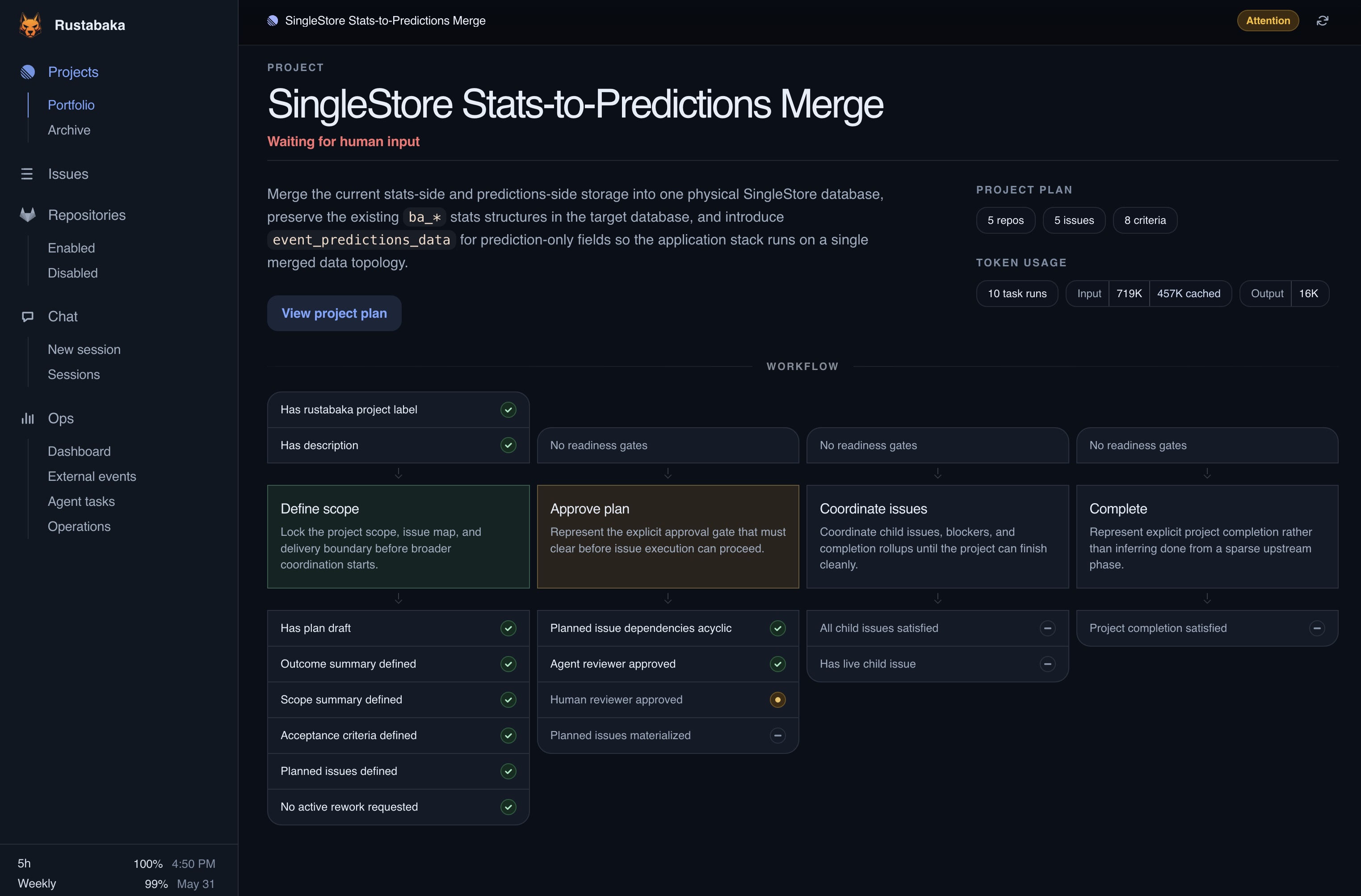
Work does not move forward invisibly. Rustabaka comes with predefined step readiness and completion gates based on engineering and project management best practices.
Deterministic checks prove prerequisites before work moves forward.
Stronger models can review or approve work before the next step unlocks.
Operators can step in when context, risk, or judgment should stay with the team.
Represent the explicit approval gate that must clear before issue execution can proceed.
Designed with enterprise in mind
Keep data, queues, and execution inside infrastructure your team already owns and operates.
Route work through the providers and gateways your organization already approves.
Run agents in constrained runtimes with scoped permissions before anything touches code or infrastructure.